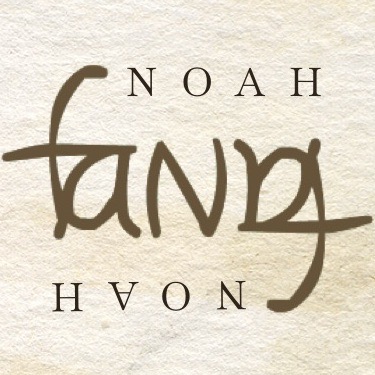
July 19th, 2026 – Where Do I Sketch My Ambigram Designs?
An ameateur as I am, I’ve got no “pro tools”. Whatever comes handy goes. That’s why almost all of my ambigrams were sketched on my Kindle Scribe using the companion pen. One device for both reading and sketching.
Of course a Kindle Scribe pen is limited in its brush options and definitively lacks the fidelity of a proper physical ink pen. But it’s good enough and convenient.
I considered buying a proper calligraphy ink pen, but decided against it. Maybe some day, when I want to sketch a lot more frequently than I do now, I might find a real pen far more handy and precise.
May 23rd, 2026 – Douglas Hofstadter’s Five Principles of Ambigram Design
In Ambigrammia, Douglas Hofstadter articulates his five principles of ambigram design:
- Legibility/clarity: “To me, that’s the sine qua non of a good ambigram. If a design has zero readings rather than two, it should be called a nullogram rather than an ambigram.”
- Grace of line (the beauty of individual strokes and letter): “…a feeling of effortless and unforced grace of line.”
- Uniformity of style (across an entire ambigram): “…a global or large-scale property. This includes the desideratum (but certainly not a rigid rule) of not mixing cases (in other words, you should eschew lowercase letters in an uppercase ambigram, and vice versa).”
- Simplicity/minimality: “…a principle that is related to that of not caking on the makeup. Less is so often more.”
- Playfulness/humor: “…another aspect of certain ambigrams (though not of all good ones) that I rank very highly…”
May 15th, 2026 – My Journey
My graphic design journey to the world of ambigrams started from an ambigram of Paul McCartney. Before then, I was only vaguely aware of such things as ambigrams upon reading news about Dan Brown’s book featuring them. I was mesmerized by the album cover and immediately started sketching myself.
The first ambigram I sketched is my family name, “Fang”, which still holds up very well to this day. Realizing its difficulty, I stopped almost right after and for a very long time I didn’t really pay much attention to it.
More than a decade has passed until I picked it up again, prompted by a conversation with a colleague. Lots more experiments followed and I have since been practicing on and off, as much as my daily schedule allows.
I read John Langdon’s book Wordplay and much later Douglas Hofstadter’s Ambigrammia. I visit the ambigrams subreddit. I follow The Spin Doctor on Youtube. I’m having a lot of fun designing ambigrams for friends and colleagues.
Ambigrams are now a fun part of my life.
 Noah’s Ambigrams